• Eternal Feminine Podcast Series,  Eternal Feminine Series - Featured Work

    Lehmann & Radclyffe Hall – Featured Work

    The Silver Rose

    text: Radclyffe Hall, 1910

    I’ll sing you a ditty of Nowhere Town.
    You climb the hill when the sun goes down,

    Step out on the roadway of golden light,
    And Nowhere Town lies along to your right.

    In Nowhere Town is a Silver Rose,
    A magic blossom that swings and grows

    So high, that never a man or maid
    Has plucked that flower from its fairy glade.

    The rose is watered by all the tears
    That lovers weep through the countless years,

    And warmed by the breath of ardent* sighs,
    And lit by the light in lovers’ eyes.

    And none may reach it to pluck, save he
    Whose love shall last through eternity.

    So some sweet evening we’ll go, we two,
    And I will gather the rose for you.


    *Lehmann omits this word.

    Return to podcast. ↵

    Subscribe to our Newsletter!

  • Eternal Feminine Podcast Series

    “Trial by Tabloid”

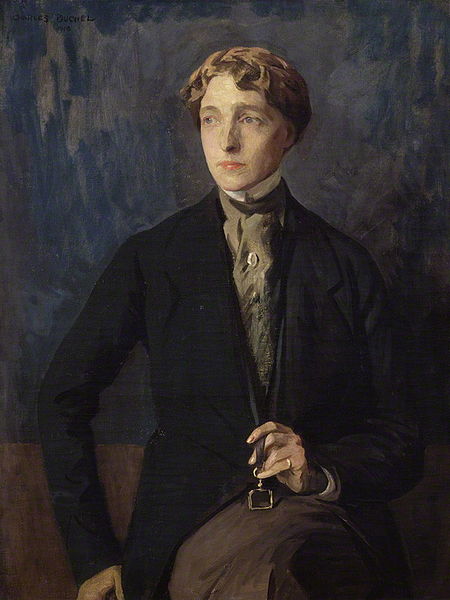
    When Radclyffe Hall decided to write her novel The Well of Loneliness, she knew its lesbian subject would be potentially controversial – not only did she first clear it with her partner, Una Troubridge, she also warned her publisher that the book she was planning would require him to have a lot of faith in her, and stated preemptively that she would not allow any modifications to her text.

    Hall herself was an out lesbian, having lived with Una Troubridge for years, and, before that, Mabel Batten. She was also a successful novelist and poet – her 1926 novel Adam’s Breed had won both the Prix Femina and the James Tait Black prize, a rare achievement. It was this success that made her think that her reputation might make it possible for a novel about “sexual inversion” (the term used by Hall, derived from the writings of Krafft-Ebing and Havelock Ellis, the latter of whom wrote a foreword to The Well of Loneliness) to gain acceptance amongst the general public – and in so doing, to raise public LGBTQ awareness and advocate for understanding in society.

    As it turned out, that was an objective that she achieved, albeit at personal cost.

    She had already experienced the homophobic media circus of the tabloids in 1920, when she sued St George Lane Fox-Pitt for slandering her as “immoral”. She won her case, but the tabloids had a field day, and the general atmosphere of the times can be seen in its fallout: a Conservative MP proposed a law against “Acts of Gross Indecency by Females”, which cleared the House of Commons but not the House of Lords. (It should be said, though, that this was not because of any enlightened attitudes on the latter’s part – on the contrary, the objection to it, as stated by the then-Lord Chancellor, Lord Birkenhead, was that such a law would bring lesbianism to the attention of women who might otherwise never know of it.)

    That said, the initial reception of The Well of Loneliness was largely positive – even the critical reviews had to do with its style rather than its theme, and it was selling so well that the publisher was planning a third print run. Trouble only came when James Douglas, the editor of the Sunday Express, published his editorial – a virulently homophobic diatribe – demanding that the novel be suppressed for its lesbian content. The publisher panicked and sent a copy of The Well of Loneliness to the Home Secretary for review, but unfortunately the Home Secretary wrote back suggesting that the book be withdrawn from circulation. Before long, things escalated into a very public obscenity trial – headed, unfortunately, by a homophobic judge who declared the book obscene, not because of any acts described in the book (it was not explicit in the least), but because its lesbian characters were presented as attractive and admirable. For that reason, therefore, he ordered the destruction of the book, and it was not until 1949, after Hall’s death, that another edition was brought out in the UK.

    (In the US, the book met legal challenges as well, when the Society for the Suppression of Vice put in a complaint of obscenity. There, however, she and her publisher won their case – the court declared the novel to not be in contravention of obscenity laws.)

    In the long term, despite all these attempts at suppression, Hall did achieve her aims. Not only did the legal struggles of The Well of Loneliness draw attention to the book itself, they also (especially in the case of the UK trial) increased the general public’s awareness of institutionalized homophobia, even in Hall’s time. The thousands of letters of support she received after the trial attest to that – she heard both from gay people who drew comfort from the novel and the presence of a protagonist with whom they could identify, as well as straight people who wrote to express sympathy at the way the trial had treated her, or to speak of how the book had changed their attitudes, suggesting that she was indeed an agent of the change that she sought to effect with her brave stand for equality.

    -Suzanne Yeo
    September 2020

    Return to podcast. ↵

    Can’t get enough?
    Visit our Bibliography page for further sources.

    Subscribe to our Newsletter!
  • Eternal Feminine Podcast Series

    “A Whole Lotta Lehmann”

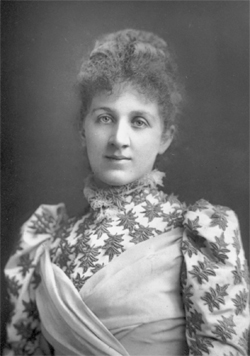
    Growing up, Liza Lehmann was part of a well-connected family, due in large part to her father Rudolph’s fame as a celebrated artist. Rudolph (Rudolf) Lehmann was born in Germany but became a naturalized British citizen in 1866, shortly after Liza’s birth. Rudolph created a series of portraits that features autographs by each portrait’s subject, which is now in the collection of the British Museum (visit our Bibliography page to view those pieces!). These portraits featured notables such as Giacomo Meyerbeer (opera composer), Baron de Reuter (founder of the Reuter News Agency), Frédéric Chopin (composer), Robert and Elizabeth Barrett Browning (playwright and poets), and Clara Schumann (composer and pianist).

    Liza’s mother Amelia Lehmann (née Chambers) was no stranger to fame either – her father was a Scottish author and naturalist whose work Vestiges of Creation preceded Charles Darwin’s work on the theory of evolution. (As it happened, Darwin was counted among one of the many famous friends of the Lehmann family). Amelia’s father apparently declared that she was so talented that she did not need any musical instruction; thus, Amelia did not have any formal training until after her marriage. According to Liza in her memoir, “[Amelia] had a wonderful ear, the gift known as ‘absolute pitch,’ and could transpose easily at sight. She wrote some beautiful music, notably an operatic setting of a Goethe libretto; but the same diffidence and exaggerated, almost morbid self-criticism, led her to destroy most of her compositions, including with them many of her best.”1 Lehmann also writes that her mother called herself the “Brutal Truth Department,” a reflection on her method of dispensing criticism to her students (and daughter).

    But however much Amelia disdained her own talents, she was determined that Liza would succeed as a performer and so the young Liza was frequently called upon to sing for friends and family that came to call on the house. Liza tells of one such occasion in her memoir when the pianist Rubinstein was entertaining at their house and charged Liza with singing for the guests. Liza had only just begun to study voice seriously and couldn’t face singing for the well-to-do of the London arts scene; she staunchly refused at her mother’s bidding. However, her father, fearing that she was going the same route of her mother (that is, pursuing music only in study, not practice) threatened to go to bed unless she sang! Suffice it to say, Rudolph had an early bedtime that evening.

    Lehmann’s marriage, followed by an unfortunate illness that damaged her voice, marked the end of her performing career and she turned to composition. Her husband, Herbert Bedford, was also a talented composer, author, artist and inventor. Together they had two sons: Rudolf and Leslie, both of whom showed promise in music and art. The family would often create and sing little rounds together during their leisure time and Lehmann’s memoir reproduces very fine portraits that each son did of the other. Unfortunately, Rudolf died at the early age of 18 while training for service in World War I, which had a profound effect on his mother. It might even be said that Liza never fully recovered from his death; she died just a few years later at the early age of 56.

    However, Liza and Herbert’s legacy persists even today. Their younger son Leslie Bedford, went on to make significant contributions in the field of engineering. Bedford’s developments in radar were crucial to the Royal Air Force during World War II and he was ultimately awarded an OBE and a CBE. Leslie married Lesley Duff, a soprano who was friends with composer Benjamin Britten and actually performed in several premieres of his operas while with the English Opera Group in the 1940s. Their three children, Peter, David, and Steuart were all musical. Peter Lehmann Bedford was a singer at Glyndebourne Opera, while David Vickerman Bedford was an influential musician, music educator, conductor, and composer whose work ranged from pieces for children’s choirs, orchestral works, pop music, and progressive rock. Steuart John Rudolf Bedford (OBE) is a conductor who is known for his work with Britten operas and has worked with such illustrious establishments as Glyndebourne, the Metropolitan Opera, The Welsh National Opera, and English Sinfonia.

    It’s somewhat bittersweet that Liza Lehmann did not live to see her family’s contributions to the world, but I think she would have been pleased to see that her legacy is very much alive today.

    -Daniella Theresia Teodoro-Dier
    September 2020

    1. Lehmann, L., 1919, See Bibliography for full citation.


    Return to podcast. ↵

    Can’t get enough?
    Visit our Bibliography page for further sources.

    Subscribe to our Newsletter!
  • Eternal Feminine Podcast Series

    Liza Lehmann & Radclyffe Hall

    If you are listening on a mobile device, please click “Listen in browser.”

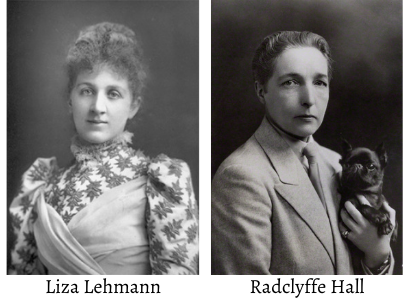
    In this episode of The Eternal Feminine Podcast Series, we discuss two women: English composer Liza Lehmann (1862-1918) and English poet Radclyffe Hall (1880-1943). Both women lived during the turn of the 19th century; Lehmann was the daughter of famed portrait painter Rudolph Lehmann and his wife Amelia, a singer, composer, and amateur artist. Liza Lehmann enjoyed a successful, if not short career as a concert singer, gaining the admiration of audiences at home and abroad. She began composing after her marriage to Herbert Bedford, an equally talented composer, writer, and inventor. Radclyffe Hall was a novelist and poet, best known for her novel The Well of Loneliness, which sought to raise awareness and understanding of lesbianism in society at large. Her first partner, Mabel Batten, was a well-known amateur singer and composer and it is likely due to this connection that Lehmann knew Radclyffe Hall and came to set her poetry.

    Listen to the full podcast to hear our discussion of these two remarkable women and our recording of the piece “The Silver Rose.”

    Read more about Liza Lehmann and Radclyffe Hall in “A Whole Lotta Lehmann” and “Trial by Tabloid”.

    Subscribe to our Newsletter!

  • Eternal Feminine Podcast Series

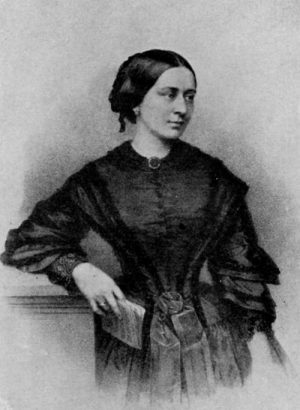
    Clara Schumann

    If you are listening on a mobile device, please click “Listen in browser.”

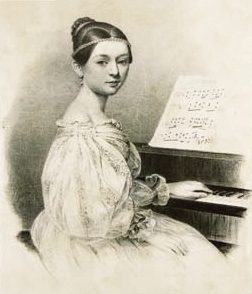
    In this episode of The Eternal Feminine Podcast Series, we discuss Clara Schumann (née Wieck) (1819-1896). Clara was born into a musical household and her father, pianist and teacher Friedrich Wieck, was determined that Clara should be a musical star from an early age. She soon won the hearts of the public, both in her native Germany and abroad, and relished her elevated status as a celebrated musician. Her marriage to the composer Robert Schumann in 1840 marked a change in her own compositional output, probably because she was the primary breadwinner of the family; Clara still gave concert tours despite having 8 children to raise and an increasingly ill husband. A fiercely determined woman, she continued touring and teaching until shortly before her death in 1896.

    Listen to the full podcast to hear our discussion of this amazing woman and our recording of Schumann’s tender Liebst du um Schönheit.

    Read more about “The Queen of the Piano.”

    Subscribe to our Newsletter!

  • Eternal Feminine Podcast Series

    “The Queen of the Piano”

    Clara Schumann was an incredibly talented musician, shrewd businesswoman, and all-around force of nature.

    As a child, her father had her copy out [often-disparaging] letters that he had written to concert-arrangers and patrons (under the guise of “improving her handwriting”), so from a young age, she gained a rare insight into the business side of music. Her father, Friedrich Wieck, also instilled in her an often-paranoid outlook on the world. Wieck saw “plots and cabals” all around, threatening to ruin his hard work and investment in Clara’s success. This attitude, combined with a determination to succeed, is possibly responsible for the single-mindedness with which she approached concert touring and her general status as a professional musician. She often viewed other up-and-coming musicians as rivals, even when she was older and had established herself as the European “Queen of the Piano.”

    Her ability to garner audiences [read: money] made her somewhat blind to the sensitivity of her husband Robert Schumann and her dogged pursuit of income was often a source of strain in their relationship. Yet Clara viewed this as her one asset with which she could support her large family, and, always the practical one, continued to accept concert engagements no matter her physical or emotional state. She played through injury on more than one occasion (noting with surprise that the audience didn’t seem to notice any change in her playing or demeanor) and seems to have been a kind of Romantic super-woman in that sense.

    Clara’s determination (not to mention, physical strength) was famously apparent when the Schumann family was forced to flee the city in the wake of the May Uprising in Dresden. Reportedly, a civil war-like atmosphere had descended, with insurgents barricading many parts of the city. Clara, Robert, and their eldest child Marie fled the city unnoticed to a haven some 20 kilometers away. But several other children had remained behind with a wet-nurse. So two days later, Clara (then 7 months pregnant) walked back through the city, faced down the insurgents, gathered up children and nurse, and walked back out! It is also said that from the time she was five, Clara enjoyed daily walks, sometimes several hours at a time (her father didn’t change his habits just because she was a child). And considering her longevity, it’s hard to say that those walks were inconsequential.

    Clara’s business sense was also apparent in her first teaching post at Dr. Hoch’s Konservatorium – Musikakademie in 1878. Not only was she the only female faculty member, but she garnered a position that was unprecedented for its time: Clara taught a maximum of 1.5 hours per day, could teach from home if she chose, and also had four months off for vacation and touring. She also demanded two teaching assistants (and who could do the job better than her two daughters!) and only taught the advanced pupils. Clara’s name and reputation helped to elevate the status of the school and brought international students, including such noted pianists as Natalia Janotha (Poland), Fanny Davies (England), Carl Friedberg (Germany), and Ilona Eibenschütz (Hungary). Even modern faculty members would be hard-pressed to find such a position!

    Though some might say that Clara’s determination may have caused some feelings of inadequacy on her husband’s part (and possible marital tension), there’s no debating that she was a woman without precedent. Clara Schumann enjoyed a 61-year career as a concert pianist in a male-dominated time: a feat befitting the “Queen of the Piano!”

    Daniella Theresia
    -September 2020

    Return to podcast. ↵

    Can’t get enough?
    Visit our Bibliography page for further sources.

    Subscribe to our Newsletter!
  • Eternal Feminine Series - Featured Work

    Schumann – Featured Work

    Liebst du um Schönheit

    text: Friedrich Rückert (1788–1866)
    translation: Daniella Theresia

    Liebst du um Schönheit,
    O nicht mich liebe!
    Liebe die Sonne,
    Sie trägt ein gold’nes Haar!
    If you love for beauty,
    Oh do not love me!
    Love the sun,
    She has golden hair!
    Liebst du um Jugend,
    O nicht mich liebe!
    Liebe den Frühling,
    Der jung ist jedes Jahr!
    If you love for youth,
    Oh do not love me!
    Love the Springtime,
    That is young every year!
    Liebst du um Schätze,
    O nicht mich liebe!
    Liebe die Meerfrau,
    Sie* hat viel Perlen klar!
    If you love for wealth,
    Oh do not love me!
    Love the mermaid,
    She has many clear pearls!
    Liebst du um Liebe,
    O ja, mich liebe!
    Liebe mich immer,
    Dich lieb’ ich immerdar!
    If you love for love,
    Oh yes, love me!
    Love me forever,
    I will love you forevermore!

    *Rückert originally wrote “Die,” meaning “Who.”

    Return to podcast. ↵