• Eternal Feminine Podcast Series

    Fanny Hensel

    If you are listening on a mobile device, please click “Listen in browser.”

    Click Here to Follow Our Podcast!

    In this episode of The Eternal Feminine Podcast Series, we discuss Fanny Hensel (née Mendelssohn, later Mendelssohn-Bartholdy) (1805-1847). Born into a prominent German Jewish family, Fanny showed promising musical talent from an early age, but was prevented from pursuing a musical career by social conventions of the time, as well as the strict opinions of her father and brother (the composer Felix Mendelssohn). She contented herself with being a “critical eye” to her brother’s works (with whom she shared a close relationship), and eventually married Wilhelm Hensel, a painter, who, happily, encouraged her in her musical pursuits. Fanny Hensel composed over 400 musical works during her short lifetime ranging from vocal and piano works to chamber works and cantatas.

    Listen to the full podcast to hear our discussion of this amazing woman and our recording of Hensel’s beautiful piece Sehnsucht nach Italien.

    To learn more about Hensel’s fascinating roots and legacy, read our article “What’s in a name?”

    Subscribe to our Newsletter!

  • Eternal Feminine Podcast Series

    “What’s in a name?”

    Both Fanny Hensel’s origins and her legacy are impressive, to say the least. Her paternal grandfather, Moses Mendelssohn, was a famous philosopher and literary critic. Moses came from humble beginnings, but soon became well-known and respected in both Jewish and German society. He was an advocate for Jewish emancipation from discriminatory laws in Germany and is credited as one of the forces behind the “Jewish Enlightenment” (HaSkalah) in the late 18th century that ultimately worked to assimilate Jews into European society.

    Moses’ son, Abraham, took this assimilation as far as he could: he converted to Protestantism and added a Germanic surname to try and distance himself from his father (and Judaism). His wife, Lea Mendelssohn (née Solomon), descended from the equally influential Itzig family. Lea’s grandfather, Daniel Itzig, was a banker for two kings of then-Prussia and as such, enjoyed a level of freedom and affluence which was rare among Jews at that time. Like Moses Mendelssohn, Itzig also worked to improve the state of the Jewish people and actually funded members of HaSkalah (including Moses’ teacher, Rabbi Israel of Zamosch).

    Many of Daniel Itzig’s thirteen children were influential in German society, particularly in their roles as patrons of the arts – two of his daughters were patrons of Mozart, while his daughter Sarah (Itzig) Levy studied with Wilhelm Friedemann Bach and also had connections with Carl Philip Emmanuel Bach. Sarah left a collection of Bach manuscripts to the Sing-Akademie of Berlin, which her niece Lea would later join, as well as her grand-nephew Felix Mendelssohn and grand-niece Fanny Hensel (the heroine of our story…you may have been wondering when we’d get back to her).

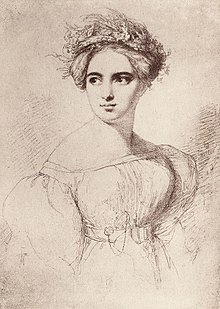
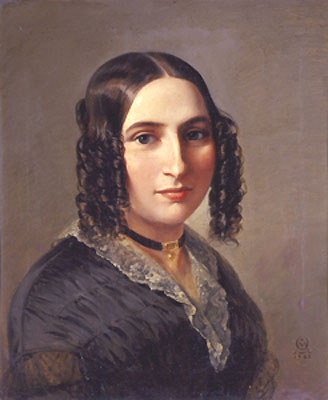
    Fanny married the painter Wilhelm Hensel in 1829 (whose portrait of her is featured on this page). Thankfully, Wilhelm did not share the Mendelssohn men’s insistence that Fanny give up music for housework and actually made it part of her daily tasks to sit at the piano every morning. Ironically, they only had one child who survived to adulthood: Sebastian Ludwig Felix Hensel. Sebastian’s numerous children included Paul Hugo Wilhelm Hensel and Kurt Wilhelm Sebastian, who each made important contributions to the sciences in philosophy and mathematics.

    Given her extraordinary lineage and musical connections, one can’t help but wonder what Hensel might have accomplished if she hadn’t been born a girl. During her youth, Hensel received precisely the same education, musical and otherwise, as her brother Felix, yet society demanded that her sole profession must be a wife and mother. Yet, even with these restrictions, she still produced an astounding amount of music for such a short lifetime. Hensel wrote over 400 works in a wide variety of genres including Lieder, piano works, chamber music, and cantatas. She was one of the first women to compose a string quartet and she even composed the organ recessional for her own wedding in the span of just hours when her brother could not due to an injury.

    From 1831 until her death, Hensel composed, arranged, and directed the music for her weekly salons, whose success did much to raise Berlin’s status as a musical hub. Through these salons and her travels, Hensel enjoyed acquaintances with many prominent musicians like Gounod, Vieuxtemps, Clara Schumann, and the critic Robert von Keudell, whom she consulted for musical advice when her brother Felix became more engrossed in his work. In fact, Hensel’s son credited von Keudell as being instrumental in her finally publishing a few of her compositions (under her married name) just before her death. In her dedication to the field and her musical sensitivity as a composer, it seems that Hensel was a professional musician in all but name.

    Return to podcast. ↵

    Can’t get enough?
    Visit our Bibliography page for further sources.

    Subscribe to our Newsletter!
  • Eternal Feminine Podcast Series,  Eternal Feminine Series - Featured Work

    Hensel – Featured Work

    Sehnsucht nach Italien

    text: Johann Wolfgang von Goethe
    translation: Daniella Theresia

    Kennst du das Land?
    Kennst du das Land wo die Citronen blühn,
    Im dunkeln Laub die Gold-Orangen glühn.
    Do you know the land?
    Do you know the land where the lemon-trees bloom,
    In the dark leaves, golden-oranges glow.
    Ein sanfter Wind vom blauen Himmel weht,
    Der Lorbeer hoch und still die Myrte steht.*
    A gentle wind wafts from the blue sky,
    The laurel tree stands tall, and the myrtle, still.
    Kennst du es wohl?
    Dahin!
    Dahin möcht’ ich mit dir,
    o mein Geliebter, ziehn.

    Do you know it well?
    There!
    I would like to go there with you,
    o my beloved.


    *the original poem reads “Die Myrte still und hoch der Lorbeer steht.

    Return to podcast. ↵

  • Eternal Feminine Podcast Series

    “There’s Something About Alma”

    Alma Mahler-Werfel has always been a bit of a legend, certainly in her capacity as muse and wife (or lover) to an impressive assortment of cultural luminaries. Her elevated status is hardly surprising, considering that her husbands included composer Gustav Mahler, the Bauhaus founder Walter Gropius, and the writer Franz Werfel, not to mention the other flings, of varying seriousness, with composer Alexander von Zemlinsky and the painters Gustav Klimt and Oskar Kokoschka.

    A good part of her mystique, of course, tends to revolve around the question of how she managed to exert such a pull over all these men, all brilliant but each so different in his own way. As Tom Lehrer famously marveled in his song “Alma”, written shortly after her death:

    Though you didn’t even use Ponds,
    You got Gustav and Walter and Franz.

    And yet she was very far from being perfect – quite the contrary, as it happens! She was extremely self-absorbed to begin with, but, more unforgivably, her anti-Semitic remarks – about Mahler, Zemlinsky, Werfel and others – as recorded in her diaries (or, in some cases, by her contemporaries) have not lost their ability to shock with their casual cruelty. But, as Sarah Connolly argues in her essay entitled “The Alma Problem”, if she was a monster, she was nevertheless a “very intriguing monster”. (Much along the same lines, Marietta Torberg, a friend, or perhaps more precisely a frenemy, famously commented that Alma was “a great lady – and also a cesspit.”)

    And certainly the men who fell for her, one after the other, did find her extremely intriguing, which was perhaps not entirely surprising. She was known for her beauty in her youth, was very well-read and accomplished (well beyond what would be expected of the typical well-brought-up young lady), and also seems to have been quite unashamed of her sexuality. All of this together in one woman must have been like catnip to men in a world where the Madonna/whore paradigm loomed large and where, as a result, women of her social class were expected to “behave” themselves and to avoid scandal.

    Despite her adventurous love life, however, Alma proved to be not entirely unconventional in her decision to become a muse to great men, rather than having a career of her own as a composer (though, admittedly, that would have been much more challenging, given the times she lived in). And so it is that, despite a relatively small, if well-crafted portfolio of compositions, we know her less for the art she created and more for the art she inspired: Mahler’s Fifth and Tenth Symphonies (book-ending their marriage), Zemlinsky’s Der Zwerg and possibly the Lyric Symphony* (both written after their breakup), many paintings by Kokoschka (most famously The Bride of the Wind).

    Nevertheless, that portfolio has survived, in no small part thanks to Mahler, who helped to get some of Alma’s music published, in an attempt to repair their marriage after discovering her affair with Gropius. It is an interesting collection, quite sophisticated in its own right, more than just a curious artifact left to us by the muse who inspired so many – and certainly enough to make one wonder what she could have come up with had she turned her not inconsiderable energies to composing instead.

    *There is some uncertainty as to whether the Lyric Symphony was inspired by Zemlinsky’s former relationship with Alma or his relationship with Luise Sachsel, the woman who would become his second wife. Somewhat piquantly, though, what we do know for sure is that Alma would play a role (albeit a supporting one) in the creation of another work related to it. Alban Berg was involved at the time in a passionate affair with one Hanna Fuchs-Robettin, and his Lyric Suite is full of encoded references to their relationship, one of which is a quotation of the line “Du bist mein Eigen” (“You are my own”) from the Zemlinsky work. Which in itself might not seem to have much to do with Alma, except that Hanna Fuchs-Robettin was also Alma’s sister-in-law through her final marriage to Franz Werfel. Berg and Fuchs-Robettin’s illicit correspondence was assisted by Alma and the philosopher Theodor Adorno (quite the pair of couriers!), who helped them carry letters to each other – a magnificent illustration of how extraordinarily entangled the artistic circles of Vienna were at the time.

    Return to podcast. ↵

    Can’t get enough?
    Visit our Bibliography page for further sources.

    Subscribe to our Newsletter!

  • Eternal Feminine Podcast Series

    Alma Mahler-Werfel

    If you are listening on a mobile device, please click “Listen in browser.”

    Click Here to Follow Our Podcast!

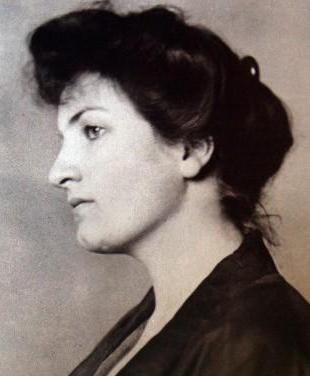
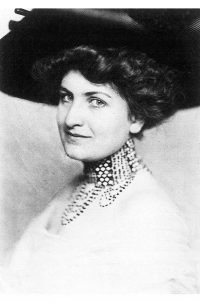
    In this episode of The Eternal Feminine Podcast Series, we discuss Alma Mahler-Werfel (née Schindler) (1879-1964). Born to a well-known Viennese painter and his singer wife, Alma gained a certain notoriety through her marriages to Gustav Mahler, Walter Gropius and Franz Werfel, and her relationships with such notables as Alexander von Zemlinsky and Oskar Kokoschka. What is perhaps somewhat less explored about Alma’s life is that she also aspired to be a composer at one point, and that she left behind a portfolio of compositions that are quite well-constructed and interesting in their own right.

    Listen to the full podcast for more about her and our live recording of Ansturm.

    To learn more about Alma Mahler-Werfel’s life, check out “There’s Something about Alma”.

    Subscribe to our Newsletter!

  • Eternal Feminine Podcast Series,  Eternal Feminine Series - Featured Work

    Mahler-Werfel – Featured Work

    Ansturm

    text: Richard Dehmel
    translation: Suzanne Yeo

    O zürne nicht, wenn mein Begehren
    Dunkel aus seinen Grenzen bricht,
    Soll es uns selber nicht verzehren,
    Muß es heraus ans Licht!
    Oh, do not be angry when my desire
    Bursts darkly out of its bounds,  
    If it is not to consume us,
    It must come out into the light!
    Und wenn herauf der Aufruhr bricht,
    Jäh über deinen Frieden strandet,
    Dann bebst du aber du zürnst mir nicht.
    You can feel how everything in me is surging,
    And when this tumult breaks to the surface,
    To suddenly become stranded over your peace,
    You will tremble but not be angry with me.

    Return to podcast. ↵

    Subscribe to our Newsletter!